
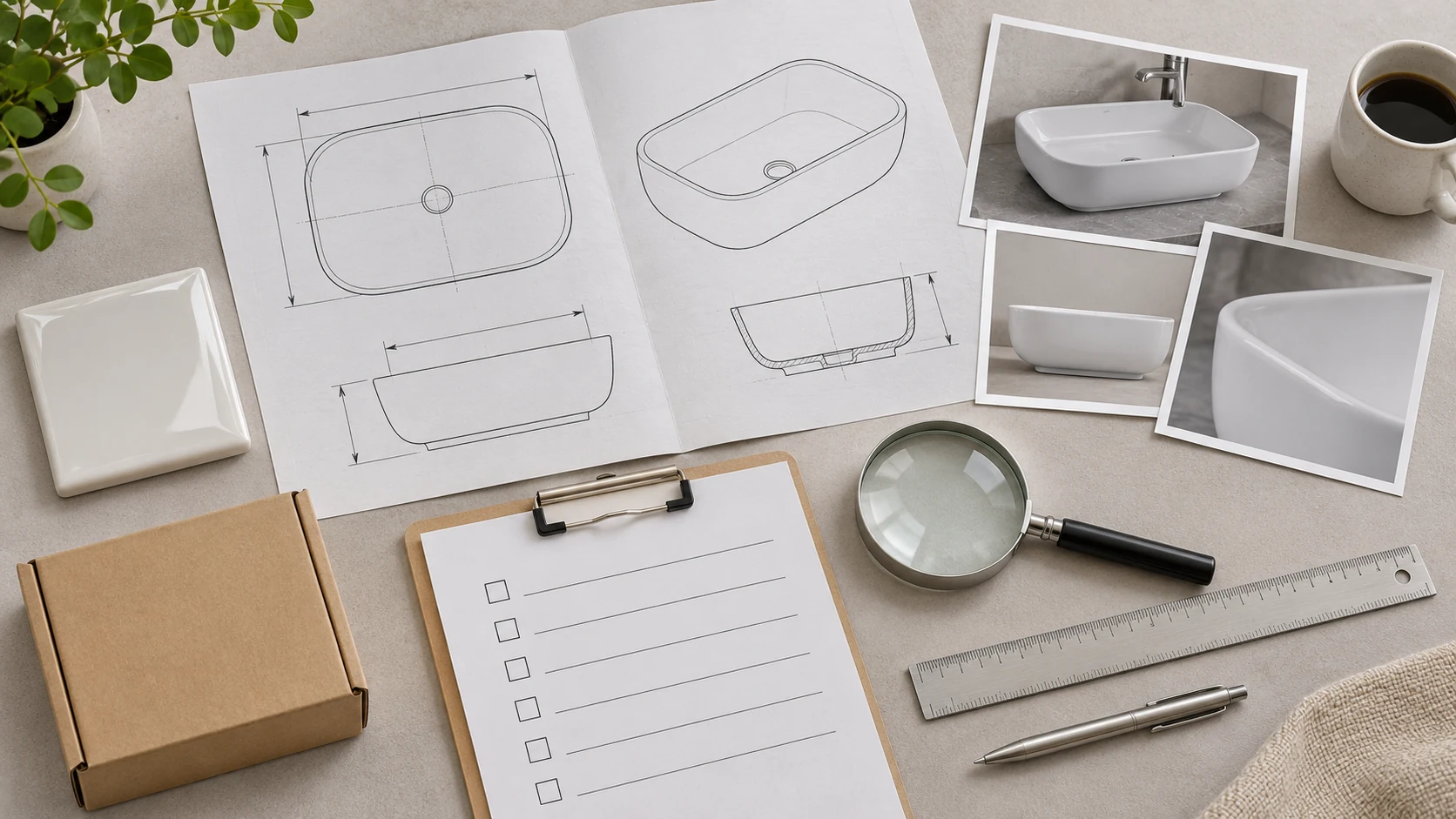
A catalogue can establish that a supplier offers relevant models. It cannot, by itself, establish who makes them, how specifications are controlled, or whether the proposed packing will survive your route. Treat supplier evaluation as a sequence of evidence requests tied to the exact products you intend to buy.
Start with the product, not the company profile
Define the intended basin, vanity top or toilet range, destination market, order mix and installation method. Then ask which listed models are current and which options require a separate approval. CADIA’s product catalogue shows model references and categories; availability, specifications and custom options still need model-specific confirmation.
For a first enquiry, choose two or three representative models. One simple item may conceal problems that appear only with a large ceramic top, a coloured finish or a toilet with a particular outlet. Ask for current drawings, clear product photographs, packing details and a sample plan for those models.
Separate capability claims from evidence
| Question to resolve | Useful evidence to request | Decision it supports |
|---|---|---|
| Who controls production? | Legal entity details, production address and permission to inspect the relevant process | Whether your audit reaches the actual production site |
| Can the specified model be repeated? | Approved drawing, sample reference and agreed inspection points | Whether later batches can be compared with the approved item |
| How are defects handled? | Proposed defect classification and inspection record format | Whether acceptance and rework decisions can be made consistently |
| How will goods travel? | Model-level carton specification, marking sample and loading plan | Whether the order can be identified and protected in transit |
These are general buyer checks, not claims that CADIA has supplied any particular record or passed an audit. If a document is unavailable, record the gap and decide whether a sample, third-party inspection or revised contract term is needed before commitment.
Test communication with a controlled enquiry
Send one concise specification sheet with dimensions, finish, quantity, destination and required response date. Ask the supplier to identify assumptions and unanswered points. A reply that flags an incompatible tap-hole position is more useful than an unqualified “yes”. Keep revision numbers on drawings and confirm whether quotations refer to the same revision.
Approve a sample against written criteria
Check the physical sample against its drawing and intended installation, including visible glaze, fixing points, waste connection and carton. Photograph the approved sample and retain its model and finish reference. A “golden sample” helps only when both parties can identify it unambiguously and agree which features may vary in production.
Trace the chain from quotation to production site
A trading company can be a legitimate sourcing partner, but the buyer should know which entity signs the contract, which site makes the selected ceramic pieces, and who can authorise changes. Request the legal name and business address on the quotation, the proposed production address for each product family, and the contact responsible for technical answers. If several sites or subcontractors are involved, list the process assigned to each one. The aim is an accurate supply map, not a preference for a particular business model.
For a remote first pass, request a dated walk-through focused on the relevant workstations, a current sample from the proposed production route, and examples of the records that will accompany your order. A generic factory video or an inspection report for an unrelated model is weak evidence. An on-site or independent audit may be appropriate when the order is large, the finish is difficult to match, or the buyer has no previous performance history with the site.
Keep a simple evidence register: document requested, model and revision covered, issuer, date received, verifier, and outstanding question. This prevents a quotation, sample photo and drawing from being treated as one approved package when their model codes differ.
Make sample approval usable on the production floor
A sample-approval record should identify the exact model, finish reference, drawing revision, tap and waste configuration, visible surfaces, approved deviations and carton version. Photograph the top, underside and installation points with a scale. If the sample has a cosmetic mark that is accepted as an exception, note whether that exception applies to the batch or only to the sample. Otherwise a later inspector has no defensible reference.
For an assembly-dependent product, test the sample in the intended counter, cabinet or mounting frame. A basin that looks satisfactory on a table may fail at the fixing interface. For a toilet, include the intended seat, flush components and outlet arrangement in the approval. Retain the sample or an agreed reference set until production and final inspection are complete.
Classify open risks before placing the purchase order
| Risk level | Example of unresolved point | Sensible next action |
|---|---|---|
| Low | A carton label is awaiting final artwork, while product specification is fixed | Approve artwork before printing and check the first carton |
| Medium | Glaze appearance is approved from photos only | Review a physical sample under agreed light before production |
| High | Outlet geometry or cabinet interface has no approved drawing | Hold the affected model until the installation fit is demonstrated |
The levels are a buyer’s decision aid, not a CADIA supplier rating. Assign an owner and due date to each open item. Do not convert a high-risk technical unknown into a note at the bottom of the order; resolve it before authorising production or state a contractual hold point. Commercial terms should specify what happens if the sample, drawing or inspection outcome changes.
Finally, align the purchase order, inspection plan and packing specification with that approval. The manufacturing overview lists relevant process questions; request actual evidence for the chosen models through the contact page.