
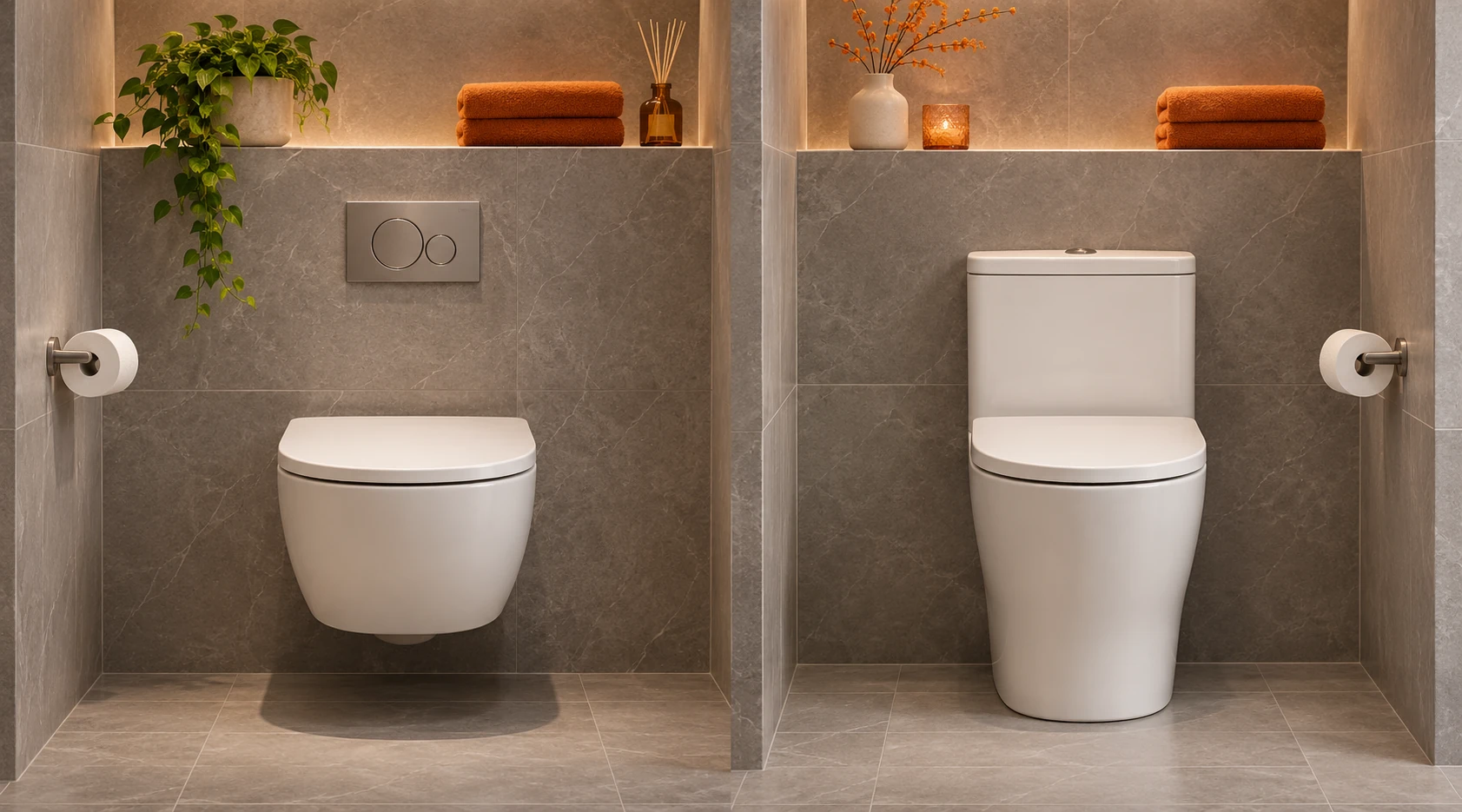
A toilet can look suitable in a catalogue and still be unusable on site. Outlet orientation, rough-in, flush components and local approval requirements must be settled before the model is quoted as a project fit.
Lock the installation system
Decide whether the project needs a floor-mounted one-piece, close-coupled, back-to-wall or wall-hung configuration. For a wall-hung model, the frame and concealed cistern become part of the specification. For a floor-mounted model, the floor outlet or wall outlet and its exact set-out are critical. Review the toilet catalogue by configuration, then request a drawing for shortlisted models.
Do not infer the trap type or outlet dimension from a product title. Ask for the current technical drawing showing outlet centre, rough-in, water inlet, fixing points and clearances. Check compatibility with the intended seat, cistern or flush mechanism where these are separate components.
Define performance and market requirements
State the destination country and the applicable project or regulatory requirements. Ask for evidence for the exact model and configuration when a certification or test result is needed. A category name or similar model’s document does not establish approval. Specify the flushing test method and acceptance criteria if the contract relies on them.
For a US WaterSense requirement, the EPA product search identifies labelled models and component combinations. Check the exact proposed model there; this article makes no WaterSense claim for CADIA products.
| Buyer question | Document to obtain |
|---|---|
| Will it fit the plumbing? | Dimensioned installation drawing |
| Is the flush assembly complete? | Bill of components and compatibility details |
| Can it enter the market? | Model-specific compliance evidence required by that market |
| Can replacement parts be supplied? | Agreed spare-part list and supply terms |
Test the complete installed assembly
Approve a sample with the actual fittings and installation arrangement. Inspect ceramic finish, seat alignment, flushing behaviour under the agreed method and packing of loose parts. For a project, confirm how replacement units and components will be identified later.
Build a model-level procurement file
A wholesale assortment and a hotel project have different replenishment needs, but both benefit from a file for each toilet configuration. Keep the ceramic model and finish code, seat model, cistern or frame reference, flush mechanism, installation drawing, carton specification and destination-market evidence together. If a component is optional, show it as a separate line rather than assuming it is in the carton.
Ask for a dimensioned rough-in drawing that the plumber can compare with the actual site. Confirm whether the outlet is intended for a floor or wall connection, the set-out from finished wall and floor, water supply position, access to the flush components and any required mounting frame. For a wall-hung toilet, the concealed system and wall construction must be approved as an assembly. A ceramic pan alone cannot establish the load path or service access.
Separate compliance evidence from product naming
Names such as “one-piece”, “wall-hung” or a market label in a category do not certify an individual model. For the intended jurisdiction, ask which standard applies, which exact model and component combination was tested, who issued the document and whether the listing is current. In North America, ASME A112.19.2/CSA B45.1 covers ceramic plumbing fixtures, but this article does not claim any CADIA item conforms to it. The buyer must check the required edition and approval route for the destination.
When a project specifies flushing performance or water consumption, define the complete tested assembly and the measurement method. Do not substitute a supplier’s general claim for a model-specific report. If the proposed seat, cistern or valve changes, review whether the earlier evidence still applies.
Plan receiving and after-sales work
On receipt, count ceramic pieces and loose parts separately, check carton marks against the order and examine representative units for cracks and shipping damage. Keep spare seat and flush-component references in the purchase file. A spare ceramic pan is of little use if its matching fitting or concealed frame cannot be identified later. For phased projects, record which batch was installed in each area to simplify replacement and defect investigation.
CADIA lists one-piece and wall-hung toilet ranges. This guide is general procurement advice; availability, performance, approvals and parts support require written confirmation for the selected model.